Race cars are built around parts you didn't design: a production cab, an axle housing, a differential, a steering rack, an engine. 3D scanning for motorsports turns those parts into accurate digital geometry, so you can design the chassis, suspension and brackets around them in CAD instead of around tape measurements and cardboard templates. You find the interference on screen, not at fit-up.
Where does race car 3D scanning pay off most? Designing a tube chassis around a scanned body or cab. Packaging suspension around scanned axles, differentials and steering racks. Fitting aftermarket parts, replicating or improving one-off components, documenting a car before you change it, and checking fabricated parts against the design. Below is how each one works, with builds we've designed at Revv Engineering. Our background is designing trophy trucks and high-performance off-road vehicles, so most of the examples come from off-road racing. The workflow is the same for any car with a chassis, a body and a suspension.
Where 3D scanning pays off in motorsports
Designing a tube chassis around a scanned body or cab
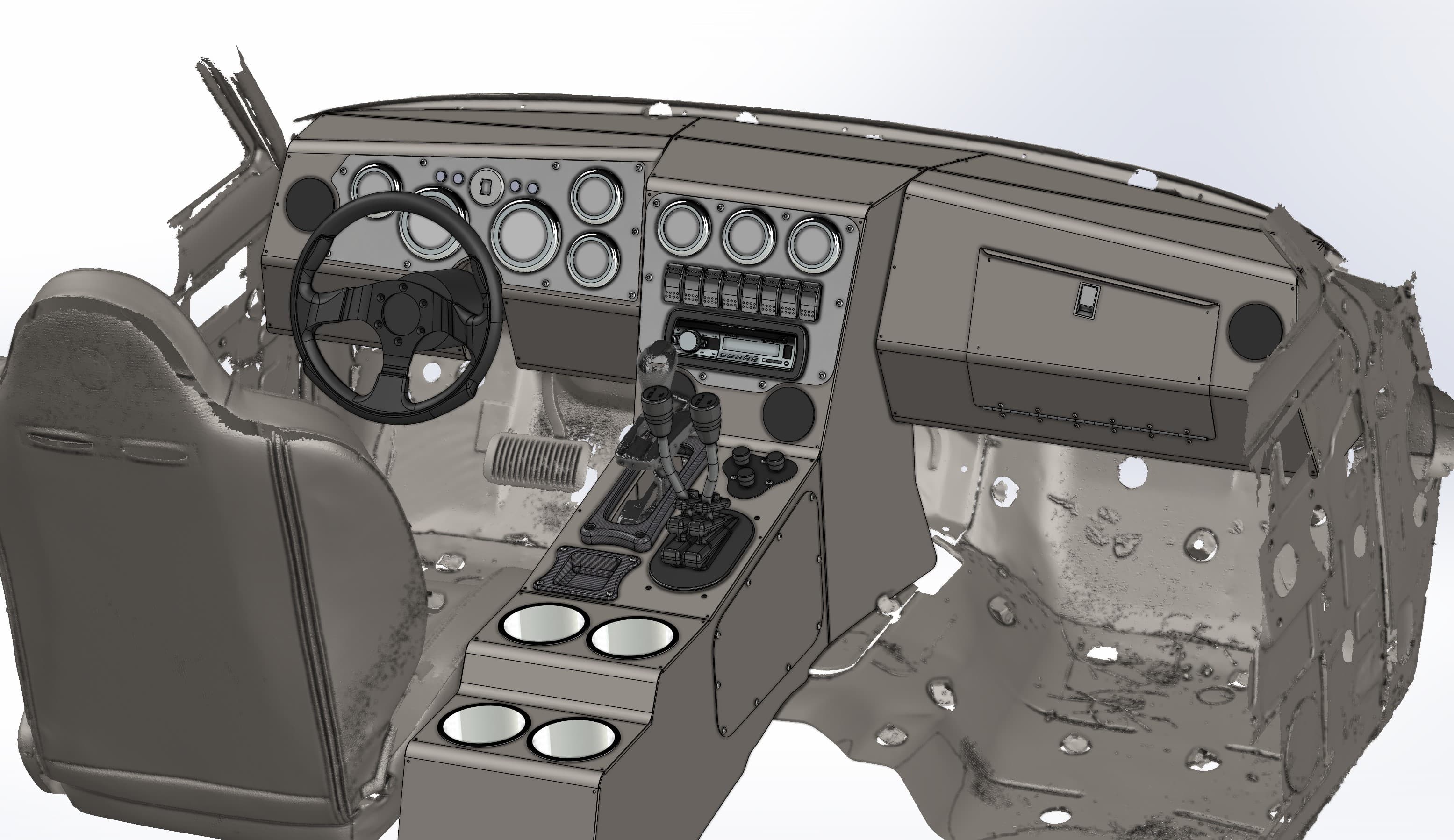
Trophy trucks, prerunners and many other race cars keep a production body shape over a purpose-built tube chassis. The cage, A-pillars, door bars and body mounts all have to land inside a shell nobody has a CAD model of. Chassis 3D scanning solves that: scan the cab or body, bring the mesh into the assembly, and design to the real roofline, door openings, firewall and floor.
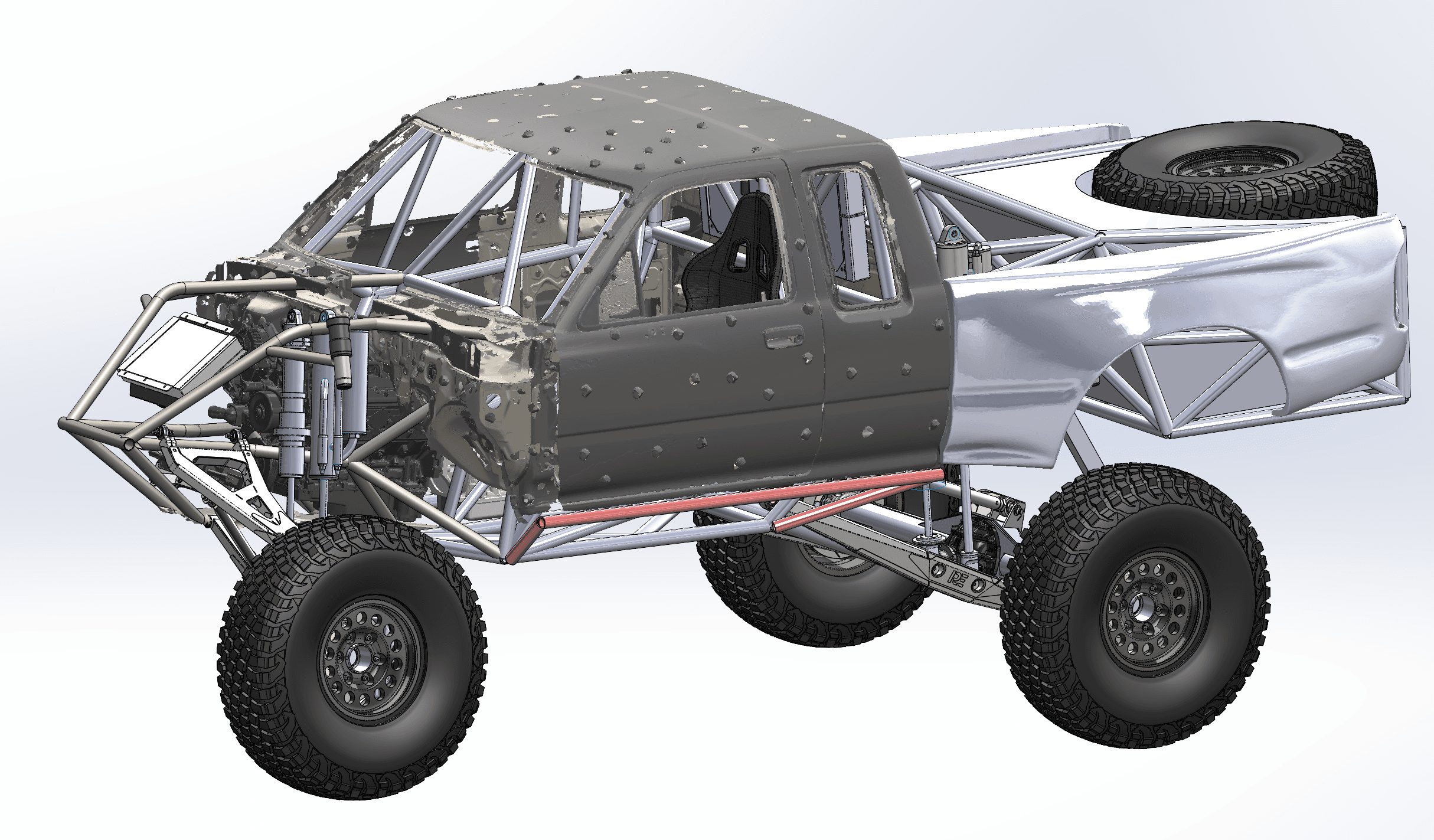
On our trophy-truck chassis design, an extra-cab pickup cab and front clip were scanned, and the full tube chassis and long-travel suspension were designed around the mesh. With the cab in the model, you can check cage tubes against the roof and pillars, set the seat and steering column inside the real cab, and confirm the tires clear the body at full bump, not only at ride height.
Packaging suspension around scanned axles, differentials and steering racks
Suspension design is mostly a packaging problem. Link mounts, shock mounts, steering geometry and skid plates have to work around housings and differentials that are castings and welds. They're hard to measure by hand and almost never available as CAD.
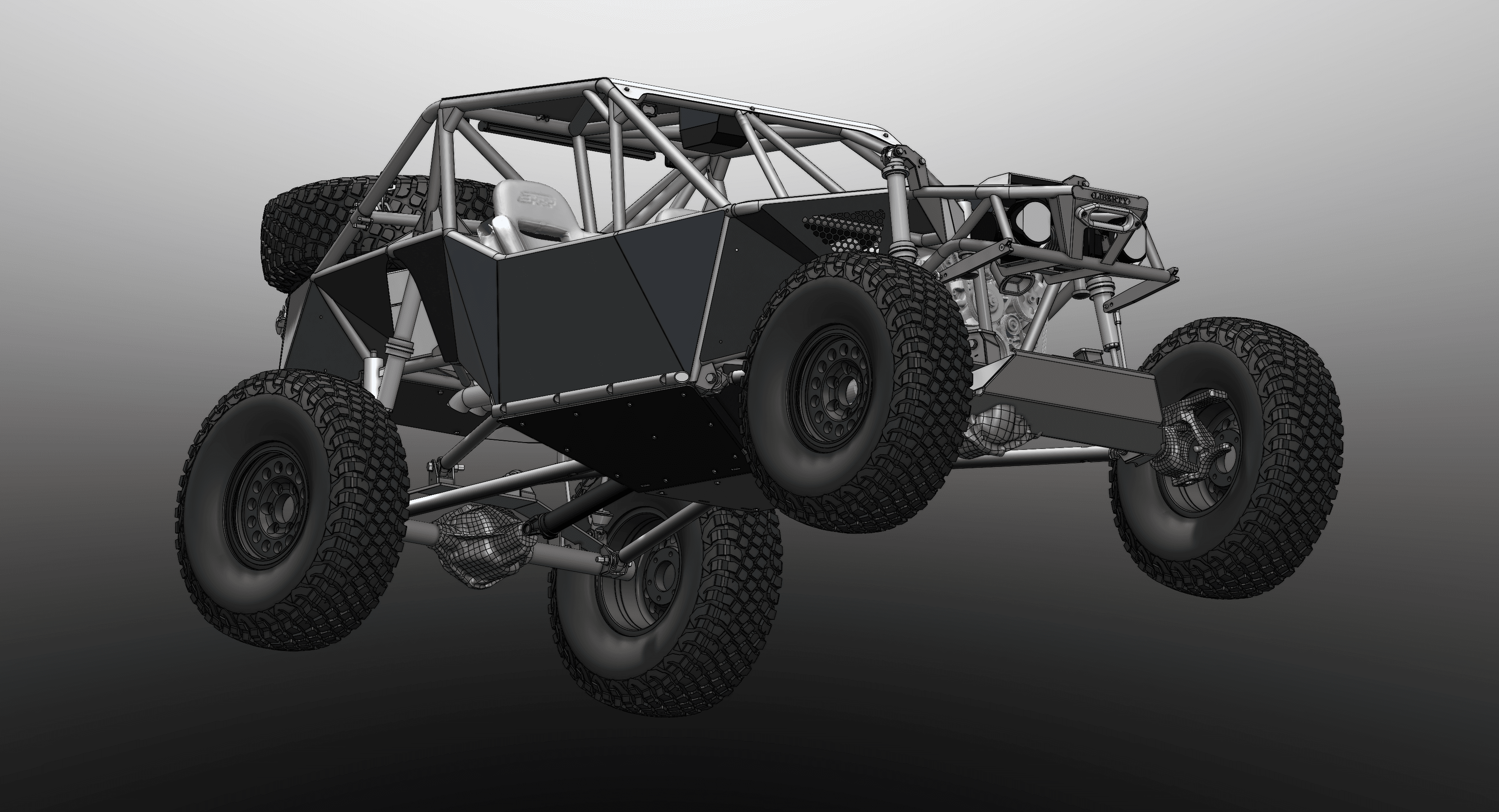
For a two-seat solid-axle race car, the axle housings were scanned and placed in the chassis assembly as meshes. With the real housings in the model, the suspension can be cycled from full droop to full bump and checked for housing-to-chassis clearance, link mount locations and skid coverage.
The same approach works for independent suspension. Our long-travel front suspension was designed around a scanned differential, steering rack and CV boots. The uprights, knuckles and arms were drawn around the real parts, so the inner tie-rod points come from the actual rack and the arms clear the actual diff housing.
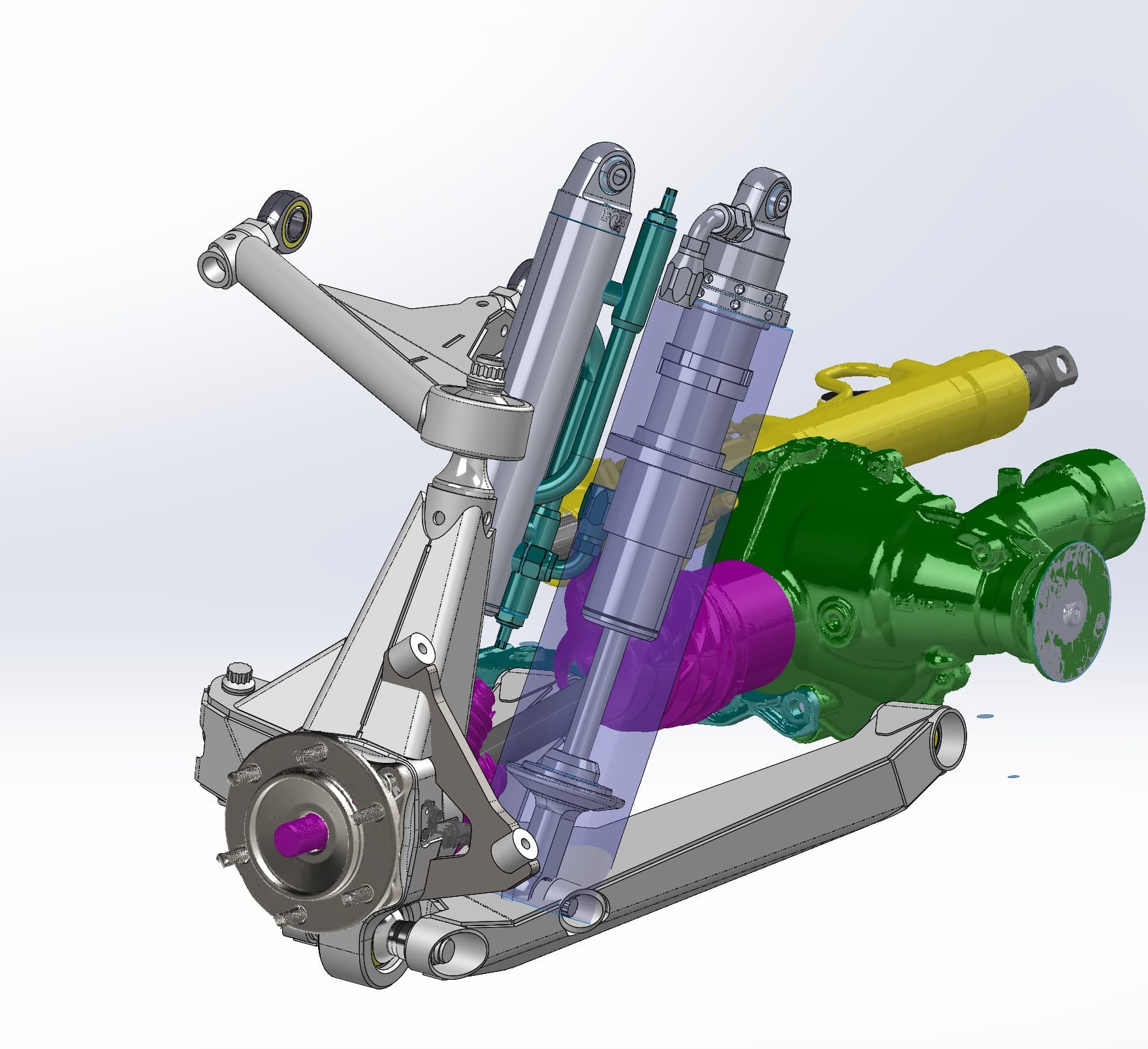
A steering rack with a few features is typically about an hour of scanning. That's a small cost next to finding a clearance or bump-steer problem after the arms are welded.
Full-car layouts and custom chassis
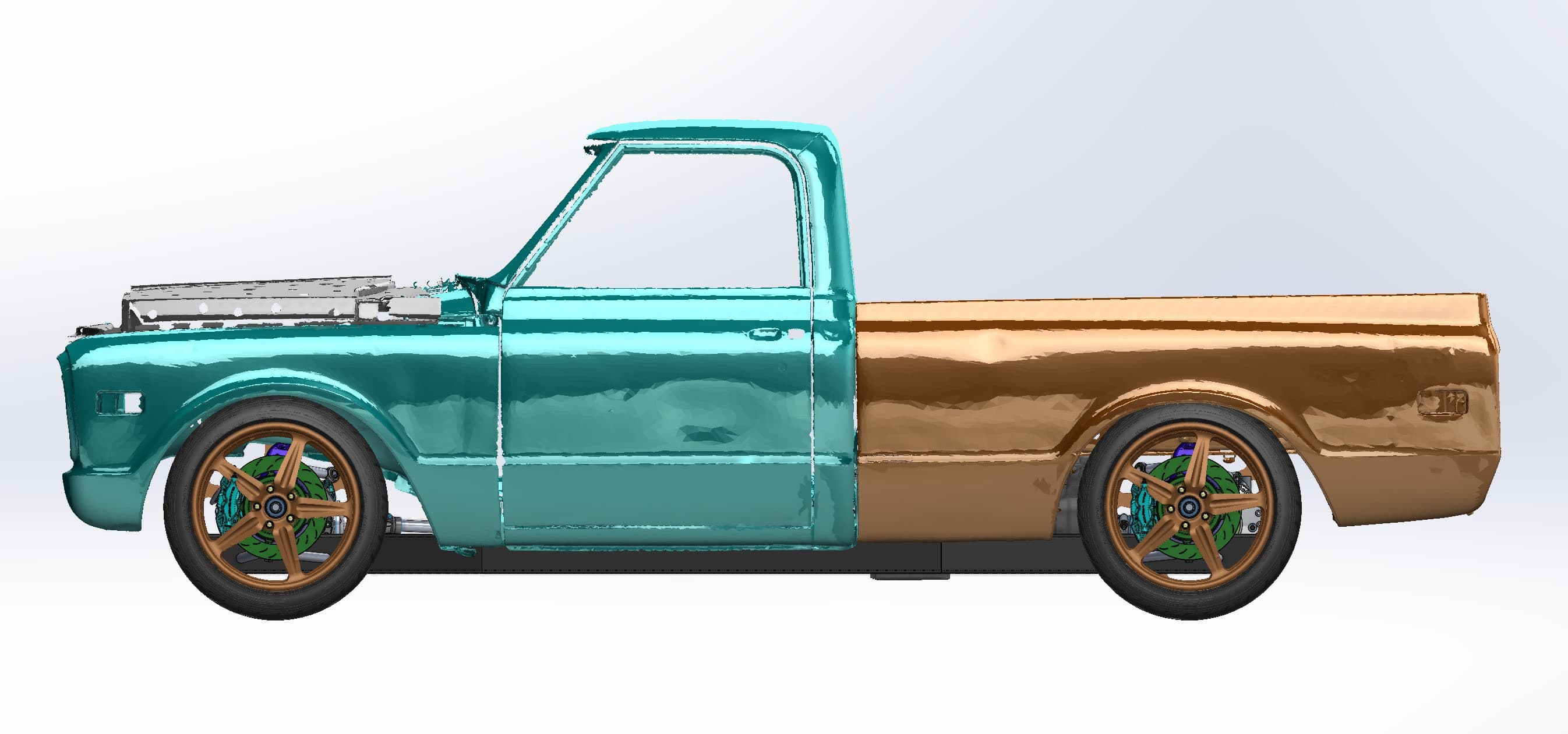
For a mid-engine C10 chassis, a '67–72 Chevy C10 body was scanned and a custom mid-engine tube chassis was designed underneath it. With the whole body in CAD, engine position, wheel placement inside the fenders, ride height and suspension travel are all settled against the real sheet metal before a single tube is bent.
Fitment of aftermarket parts
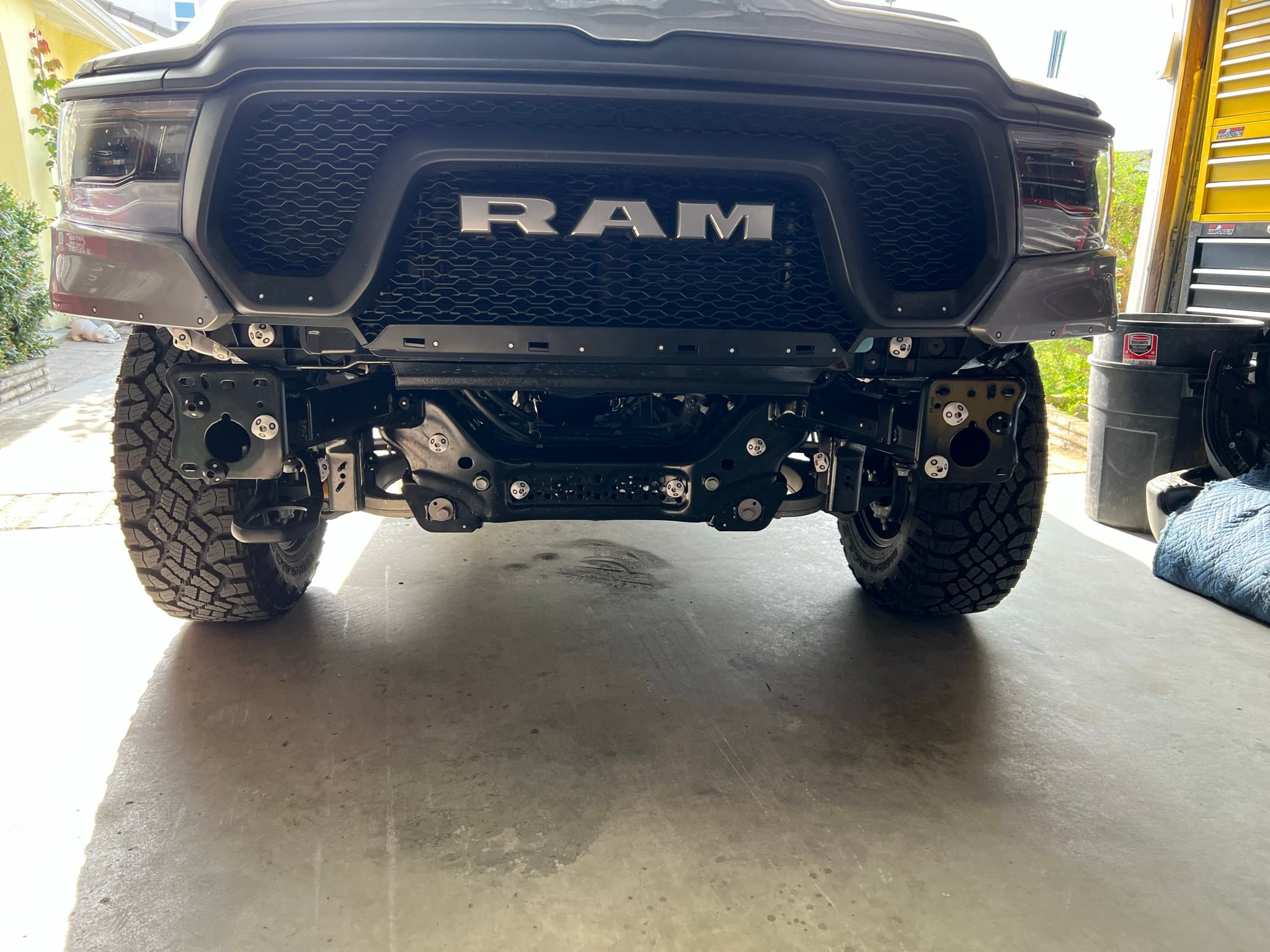
Bumpers, skid plates, bed cages, light mounts and radiator mounts live or die on fitment. Scan the mounting area with the old part removed, design the new part against the real frame horns, bolt holes and body lines, and check clearance to everything nearby. If you make parts to sell, one well-prepared scan of a representative vehicle becomes the reference for the whole product.
Replicating or improving one-off components
Race cars collect hand-built brackets, discontinued castings and parts from suppliers that no longer exist. Scan the part and whatever it mates to, reverse engineer it into CAD, and you can make spares or fix the weakness: add material where it cracked, change the material, move a mount. If the part is broken or worn, the scan shows what's left and the CAD model restores the intended shape.
Documenting a car before you change it
Before a teardown, restoration or major rebuild, scan the car as it sits. You get a permanent record of body shape, suspension pickup points and ride height that you can go back to. Historic race cars benefit most, because original bodywork gets recorded before panels are repaired or replaced. A baseline scan also gives you something to compare against after a crash.
Checking fabricated parts against the design
Welding pulls tube, and fixtures get knocked. Scanning a welded chassis, cage or subassembly and comparing it to the CAD model gives you a color deviation map of where it moved. Do it while the part is still on the fixture and easy to correct. We've used this to verify the tolerances of bent-tube cage hoops sitting on a fixture table.
What a race car scan job looks like
- Start with the design question. What are you designing, and what does it have to clear? That decides what gets scanned and what gets stripped. A cage design wants a stripped cab. A bumper design wants the old bumper off and the frame horns exposed.
- Prep. We place positioning targets. On chrome, polished aluminum or black powder coat we use a sublimating scanning spray, which disappears on its own.
- Scan. We use handheld blue-laser and structured white-light scanners, with accuracy up to 0.03 mm (0.0012 in). Our published guide puts a steering rack with a few features at about 1 hour, complex surfaces or many features at 2–3 hours, and a complete vehicle inside and out at 8–12 hours.
- Deliver. You get a mesh (STL, OBJ or PLY) to drop into your CAD as a reference, CAD in STEP, Parasolid (X_T) or IGES for parts you need to edit or machine, or both. If you'd rather we do the design work, we design in SolidWorks.
You can drop the car or parts off in Reno (same-day scanning can be arranged), ship parts to us, or have us come to your shop.
Why work with engineers who design off-road race vehicles
Scanning is half the job. The other half is knowing what the designer needs from the data. Revv Engineering was founded by Joshua Frey, who holds a B.S. in Mechanical Engineering from the University of Nevada, Reno and has design experience on trophy trucks and high-performance off-road vehicles. So when we scan an axle for a chassis designer, we're thinking about axle tube axes, pinion angle, ball-joint locations and mounting faces, not just a good-looking mesh.
If you want the chassis or suspension designed too, the same team that scanned the car does the CAD, so nothing gets lost in a handoff between a scanning vendor and a design shop.
We're based in Reno, Nevada, serve Reno-Tahoe, Northern Nevada and Northern California, and travel anywhere in the US. See more race and off-road work on our motorsports 3D scanning page, or get an instant estimate for your car or parts.