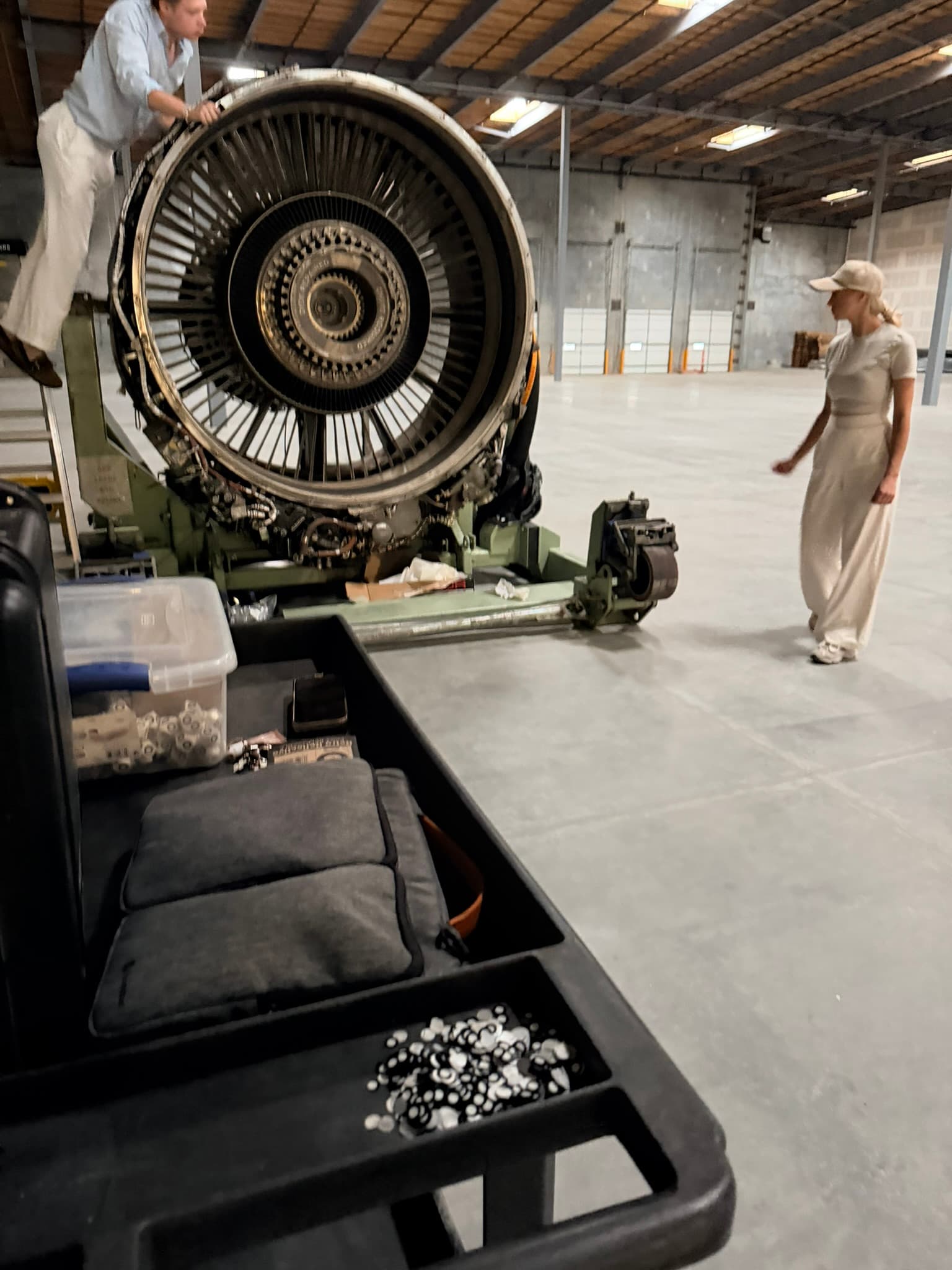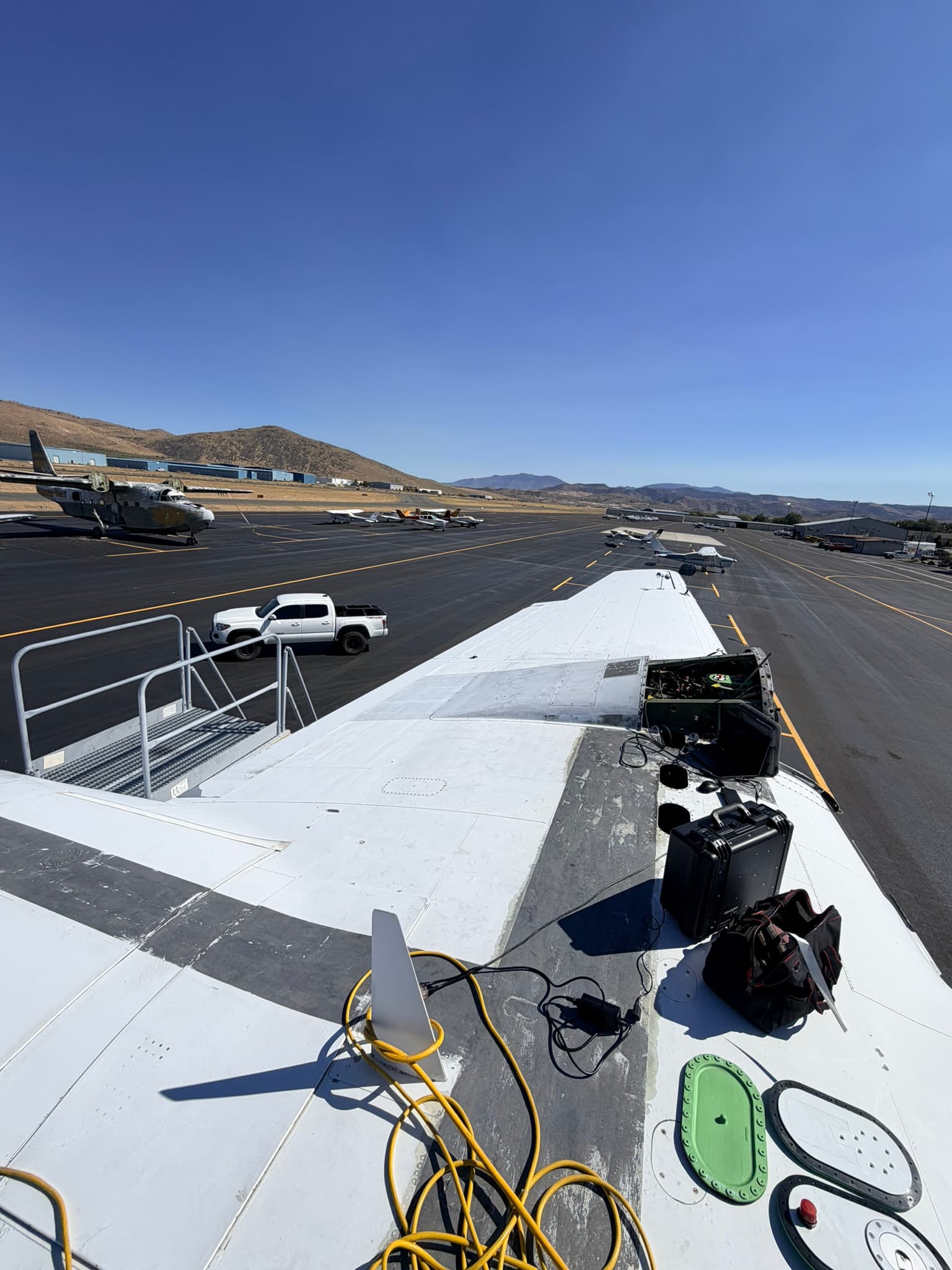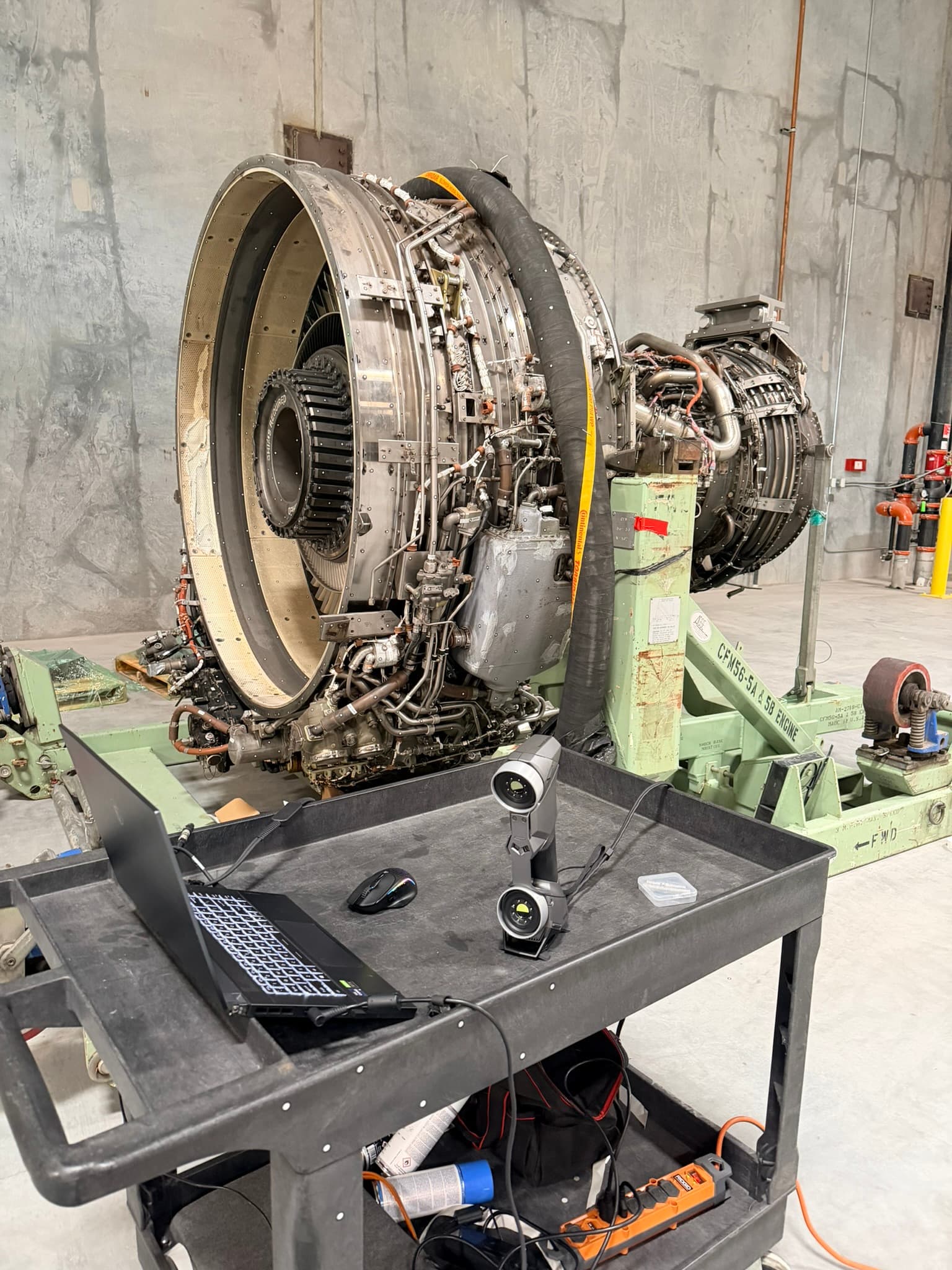
Some things don't come to the scanner. A CFM56-series turbofan sitting on its transport stand is one of them. When an aviation customer needed the engine's geometry in digital form, we brought the scanner to the engine: a handheld 3D scanner, a laptop cart and a tray of positioning targets, set up in the hangar beside the stand. This jet engine 3D scan was done on site, with the engine staying exactly where it was.
The job: digitize a turbofan without moving it
Moving an engine to a scanning room means rigging, transport and risk to hardware that is expensive to replace. Handheld scanning flips that around. The scanner is light enough to carry around and over the engine, so the engine stays on its stand and the work happens around it.
The engine was on a green transport stand with its plumbing, harnesses and accessory gearbox exposed. That kind of surface is slow and error-prone to measure by hand: tubes, brackets and housings at every angle, packed close together. A scan captures them as one dataset.
On-site setup in the hangar
Our setup was simple on purpose. The cart carried the laptop running the scan software, the handheld scanner and the power we needed. A tray of loose reflective targets rode along for prep.
Those positioning targets matter on a part this size. The scanner tracks them to know where it is in space, which lets separate passes around a large object come together as one aligned mesh. Shiny or dark areas can be prepped with a sublimating scanning spray that disappears on its own, so nothing is left behind on the hardware.
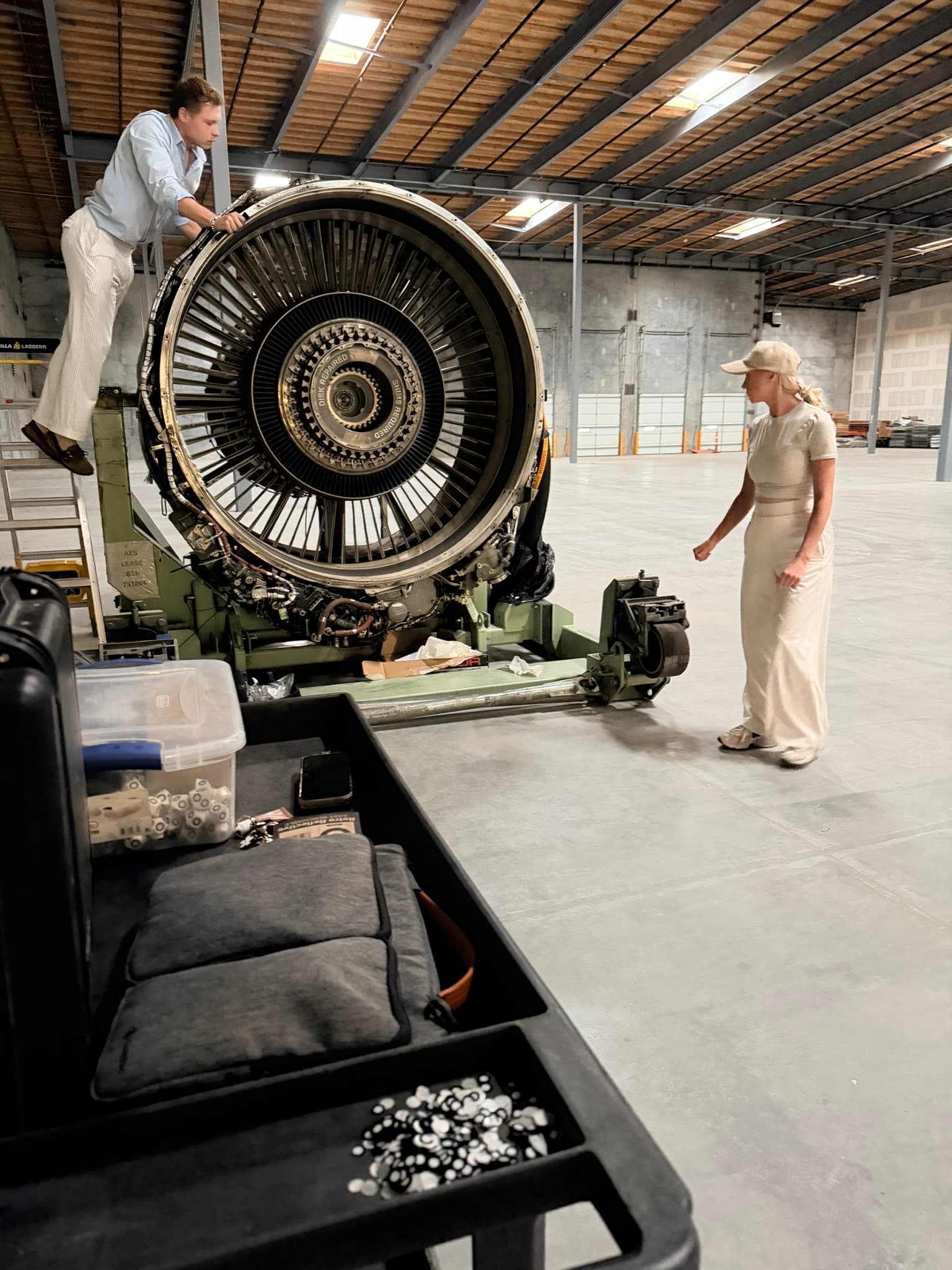
Working on site also means fitting in with the customer's space and schedule. The engine, the stand and the hangar stay theirs. We bring what we need on a cart and work around them.
What a scan delivers for aviation work
The output of a job like this is a scan mesh: the as-scanned record of the engine on its stand, ready for the customer's engineering team. They decide what it's used for. When modeled features are needed, we can also turn a mesh into CAD in STEP, Parasolid (X_T) or IGES.
Our scanners are specified at accuracy up to 0.03 mm (0.0012 in). What a given job achieves depends on the size of the part, its surfaces and the setup, so tell us your tolerance needs up front.
Why on-site engine scanning makes sense
Engines and large aircraft components are hard to move and awkward to measure. Scanning them where they sit gives an engineering team accurate geometry for things like stands, covers, cradles and installation hardware, or a record of condition, without taking the hardware anywhere.
We're based in Reno, Nevada and travel anywhere in the US with the scanners. Read how on-site 3D scanning works at a hangar or shop, see our aerospace 3D scanning page, or go deeper in 3D scanning for aerospace and aviation. When you're ready, get an instant estimate for your engine or component.